National Water at the Cost of Fuel?
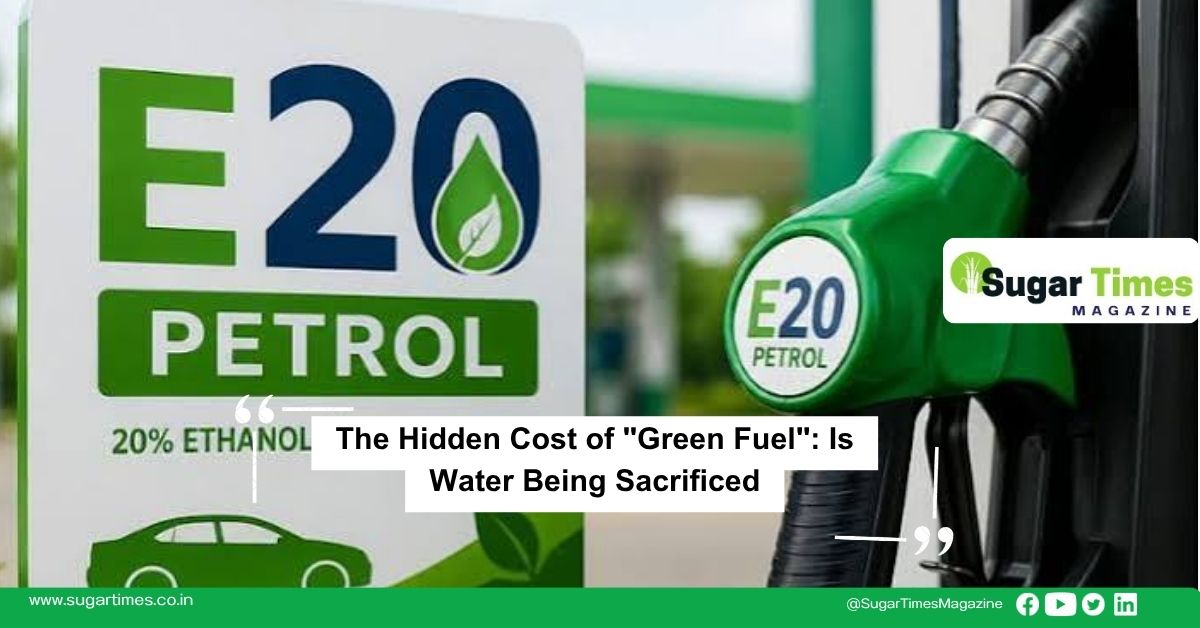
The most serious aspect of ethanol production is its high water consumption. Producing just one liter of ethanol requires thousands of liters of water, especially when it is made from crops such as rice, maize, and sugarcane.
For example:
- Producing one liter of ethanol from rice requires more than 10,000 liters of water.
- Ethanol from sugarcane and maize also consumes thousands of liters of water.
This raises an important question: Is this model sustainable for a country like India that already faces severe water scarcity? In many parts of the country, groundwater levels are already declining rapidly. Increasing water use for ethanol production could further worsen the water crisis.
The "Food vs Fuel" Challenge
Another major concern is food security.
The crops used to produce ethanol—such as rice, maize, and sugarcane—are also the backbone of India's food system. Experts believe that if a large share of these crops is diverted toward fuel production, it could put pressure on food supplies and increase food prices.
Several reports also suggest that farmers may prefer cultivating ethanol-producing crops because they are more profitable, reducing the area under food crops. In the long run, this could disturb the country's food balance.
Rice-Based Ethanol: A Growing Controversy
The use of rice for ethanol production has become the most controversial aspect of the ethanol policy.
The government has steadily increased the amount of rice allocated for ethanol production. Critics argue that this is the same rice that should be distributed to poor families through the Public Distribution System (PDS).
If this rice is diverted for fuel production, it could directly affect the food rights of economically weaker sections of society. Therefore, this is not just an economic issue but also a social and ethical one.
Is Ethanol Really Environment-Friendly?
Ethanol is often promoted as a cleaner alternative to petrol because it produces lower carbon emissions.
However, many experts question this claim. They point out that large-scale ethanol production requires extensive farming, irrigation, and fertilizer use, all of which place additional pressure on the environment.
Technical Challenges
There are several technical challenges associated with ethanol blending.
- Not all vehicles in India are compatible with higher ethanol blends.
- Higher ethanol blends may affect engine performance.
- Fuel efficiency (mileage) may decrease.
- Vehicle maintenance costs may increase.
- There are also concerns regarding supply chains and production capacity.
Unless these issues are addressed in time, the policy may fail to achieve its intended objectives.
The Need to Explore Alternatives
Experts believe that instead of abandoning the ethanol policy, it should be implemented in a balanced manner.
Greater emphasis should be placed on second-generation (2G) ethanol, which is produced from agricultural residues rather than food crops. This would reduce pressure on food production.
Other necessary measures include:
- Better water management.
- Wider adoption of drip irrigation.
- Promotion of low-water-consuming crops.
- Increased investment in electric vehicles and green hydrogen as alternative energy sources.
Balance Is the Real Solution
India's ethanol policy represents an important step toward energy transition.
On one hand, it supports energy self-reliance and environmental protection. On the other hand, it poses potential risks to water resources and food security.
Therefore, policymakers must strike a careful balance so that the pursuit of development does not come at the cost of natural resources or the welfare of vulnerable sections of society.
The dream of "green fuel" will truly succeed only if it is sustainable and inclusive, rather than creating new problems for the future.
Government's Arguments and Benefits
According to the government, the ethanol blending programme has delivered several benefits:
- It has reduced India's dependence on imported crude oil, saving valuable foreign exchange.
- It has provided additional income to sugarcane farmers.
- It has ensured a more stable market for sugar mills.
- It has strengthened the rural economy.
The government is now working toward higher ethanol blends such as E20, E85, and E100, with the aim of further reducing dependence on petrol in the future.