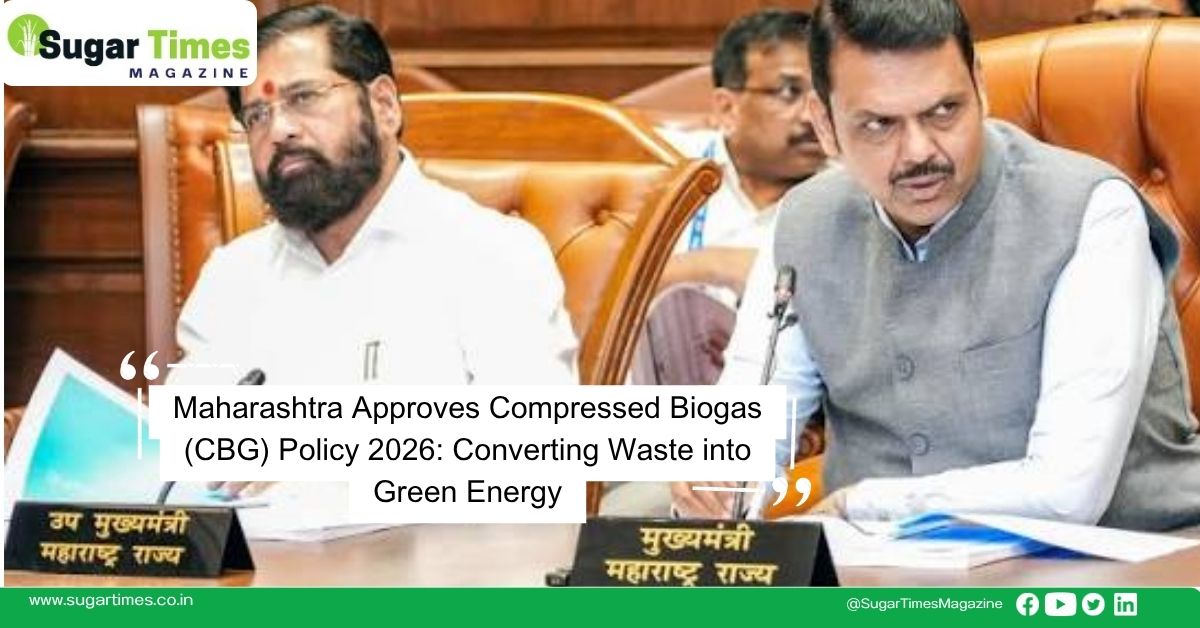
The Maharashtra Cabinet, chaired by the Chief Minister, has approved the Maharashtra State Compressed Biogas (CBG) Policy 2026.
The policy aims to:
- Improve waste management,
- Promote energy self-reliance,
- Convert urban waste and agricultural residues into renewable fuel,
- Reduce pollution,
- Ensure better utilization of available resources.
24,500 Metric Tonnes of Waste Generated Every Day
The state's 423 urban local bodies generate approximately 24,500 metric tonnes of municipal solid waste every day.
A large proportion of this waste is organic (biodegradable), but only a small quantity is currently used for:
- Compost production, or
- Biogas generation.
As a result, much of the waste ends up in landfills, contributing to:
- Land pollution,
- Groundwater contamination,
- Environmental degradation.
Better Use of Agricultural Residues
Every year, Maharashtra generates more than 20 million tonnes (2 crore tonnes) of agricultural residues, much of which is either burnt or wasted.
Under the new policy, these residues will be used for producing clean energy, reducing waste burning and associated pollution.
Minimum Feedstock Requirement for Each CBG Project
Each CBG project must have access to at least 200 tonnes of biodegradable waste per day.
To ensure sufficient feedstock:
- Smaller urban local bodies will be grouped into clusters.
- The government plans to establish at least one CBG project in every taluka (sub-district).
Role of Farmers and Farmer Producer Organisations (FPOs)
Farmer Producer Organisations (FPOs) will play an important role by supplying:
- Sugarcane residues,
- Soybean waste,
- Livestock waste,
- Other agricultural biomass.
The government will also develop:
- A dedicated online portal,
- A mobile application,
to facilitate biomass collection and supply.
₹500 Crore Funding and Subsidy Support
For 2026–27, the government has proposed a ₹500 crore Viability Gap Funding (VGF) scheme.
Financial support includes:
- Up to ₹10 crore subsidy per project.
Projects will be implemented through:
- Public–Private Partnership (PPP),
- Hybrid Annuity Model (HAM).
Urban local bodies will pay tipping fees for waste supplied, while the government will ensure priority access to electricity and water for these projects.
Major Objectives of the Policy
The key goals of the CBG Policy are:
- Increase compressed biogas production.
- Promote the use of CBG in:
- Industry,
- Transportation,
- Households.
- Generate employment and attract investment.
- Contribute to India's Net Zero emissions target by 2070.
- Make segregation of waste into biodegradable and non-biodegradable categories mandatory to improve biogas production.
Maharashtra's 2025–26 Sugarcane Crushing Season Concludes
The 2025–26 sugarcane crushing season in Maharashtra has officially ended.
Highlights:
- Average crushing season lasted 105 days.
- Total sugarcane crushed:
- 104.558 million metric tonnes (10 crore 45 lakh 58 thousand metric tonnes).
- Total sugar production:
- 9.918 million metric tonnes (99.18 lakh metric tonnes).
- Average sugar recovery:
- 9.49%.
Pune and Solapur Led in Sugarcane Crushing
Pune Division
- 32 sugar mills
- Crushed 22.255 million metric tonnes of sugarcane.
Solapur Division
- 49 sugar mills
- Crushed 22.205 million metric tonnes of sugarcane.
These two divisions recorded the highest crushing volumes in the state.
Kolhapur Achieved the Best Performance
Kolhapur division recorded the best performance in both sugar production and sugar recovery.
Key figures:
- 38 sugar mills
- Sugarcane crushed:
- 21.046 million metric tonnes
- Sugar produced:
- 23.191 million quintals
- Highest sugar recovery:
- 11.02%
Sugar Mills Operating in Maharashtra
During the 2025–26 season:
- Total sugar mills operating:
- 209
- Cooperative sugar mills:
- 102
- Private sugar mills:
- 107
Future Goal: 150-Day Crushing Season
According to Dr. Sanjay Kolte, the crushing season was successfully managed as per the ministerial committee's strategy.
For the coming years, the focus will be on:
- Increasing daily crushing capacity,
- Raising sugarcane productivity,
- Achieving a 150-day crushing season, thereby improving the efficiency and competitiveness of Maharashtra's sugar industry.