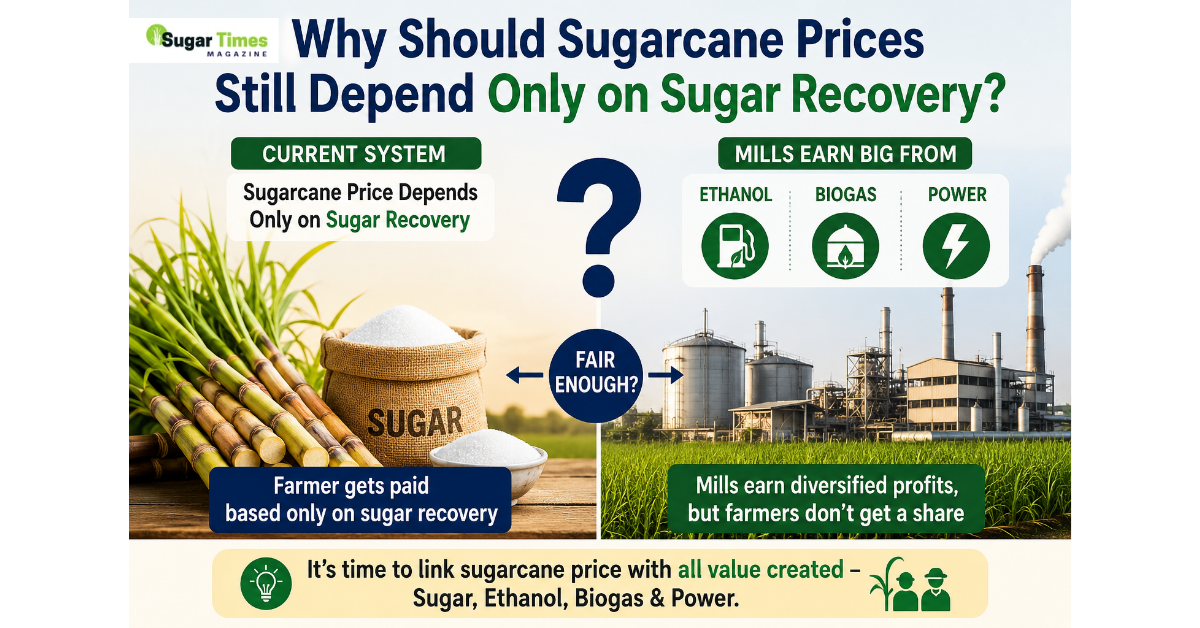
Sugar mills are earning huge profits from ethanol, bio-gas and electricity, yet sugarcane prices are still decided mainly on the basis of sugar recovery. Farmers argue that this outdated pricing formula is unfair because mills have transformed into multi-product bio-refineries. They believe the income generated from ethanol, bagasse-based power and compressed biogas should also be included in the sugarcane pricing mechanism. After all, why should farmers bear the political burden of keeping sugar prices low for consumers while mills continue expanding their revenues?
India’s sugarcane farmers, who sweeten the nation’s economy, increasingly feel cheated by the existing pricing system. Governments proudly highlight how sugar mills are no longer limited to producing sugar and are now contributing to energy security through ethanol, green electricity and bio-gas production. However, despite these new revenue streams, the financial benefits are barely reaching the farmers whose sugarcane makes all of this possible.
Today, sugarcane pricing in India is still largely based on the “Sugar Recovery Rate.” The Centre fixes the Fair and Remunerative Price (FRP) using a benchmark recovery rate of 10.25%. The same benchmark heavily influences State Advised Prices (SAP) as well. If recovery falls below 10.25%, farmers face a deduction of Rs 3.56 per quintal for every 0.1% decline.
But farmers are now questioning this decades-old approach. When sugar mills have evolved into integrated bio-refineries generating multiple streams of income, why should sugarcane prices depend only on sugar production?
Every Part of Sugarcane Generates Revenue
Modern sugar mills earn from nearly every by-product of sugarcane:
Press Mud: Used for producing compressed bio-gas (CBG)
Bagasse: Burned to generate electricity sold to power grids
Molasses: Processed into ethanol for India’s ethanol blending programme
Farmers argue that if mills are earning from all these sectors, then the revenues from ethanol, electricity and bio-gas should become a mandatory component of sugarcane price calculations.
Has Ethanol Really Benefited Farmers?
The government and sugar industry often claim that India’s ethanol blending programme has greatly benefited sugarcane farmers. However, many farmer groups disagree with this narrative.
Their argument is simple: sugar mills are earning crores through ethanol sales, but farmers are not receiving any direct premium for supplying cane used in ethanol production. They continue to get paid under the same old sugar recovery-based formula.
Supporters of the ethanol programme also point to faster payments to farmers. But farmer leaders counter that mills are legally required to clear sugarcane dues within 14 days under existing laws — something many mills still fail to do consistently. Therefore, slightly improved payment timelines cannot be projected as a special benefit of ethanol policy.
Incomplete Calculation of Farming Costs
Farmer organisations also allege that the current cost calculation system itself is flawed. While production expenses are considered, several critical components are either underestimated or ignored completely, including:
•Actual land rent value
•Interest on invested capital
•Agricultural risk
Round-the-clock farm management and labour supervision
Without accounting for these costs, they argue, the real cost of sugarcane cultivation can never be accurately determined.
Cheap Sugar for Consumers at Farmers’ Expense?
Another major concern among sugarcane growers is the policy objective of ensuring sugar availability to consumers at “reasonable prices.”
Farmers believe governments intentionally control sugar prices in the market to avoid inflation and political backlash. As a result, the burden of maintaining affordable sugar effectively falls on farmers through lower cane prices.
Farmer groups argue that if the government wants to provide cheap sugar to consumers, it should do so through direct subsidies rather than suppressing sugarcane prices.
Time for a New Sugarcane Pricing Formula
The debate over sugarcane pricing has intensified as mills increasingly diversify beyond sugar production. Farmers say the old recovery-based pricing formula no longer reflects the modern economics of the sugar industry.
The issue has now reached policymakers. Bharatiya Kisan Union (Apolitical) national spokesperson Dharmendra Malik has reportedly written to the Ministry of Consumer Affairs, Food and Public Distribution demanding that the proposed Sugar (Control) Order, 2026 include revenues from ethanol, electricity and bio-gas while determining sugarcane prices.
The demand represents a larger question facing India’s sugar economy: should the benefits of the biofuel revolution remain concentrated with sugar mills, or should sugarcane farmers also receive a fair share of the expanding profits?