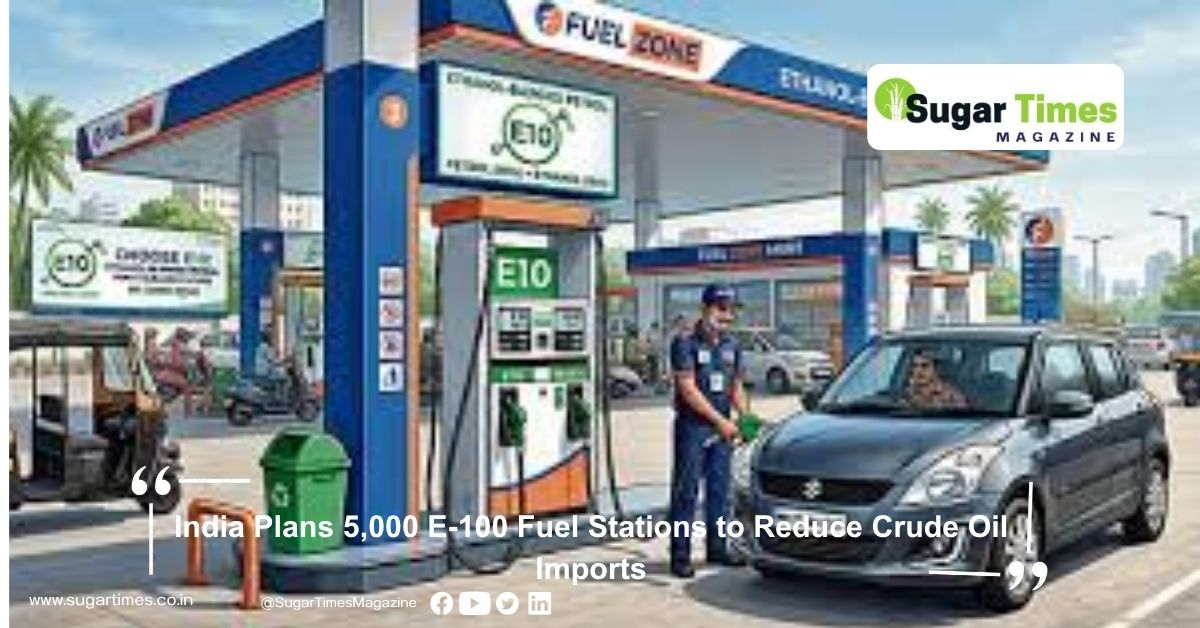
The Government of India is now moving rapidly towards promoting 100% ethanol-based E-100 fuel in order to reduce the country's dependence on crude oil imports. Under this initiative, around 5,000 new E-100 flex-fuel stations are planned to be established across the country over the next two years.
According to the roadmap prepared by the Ministry of Petroleum, the project will be implemented in multiple phases. The first phase will focus on major cities. Within the next month, nearly 150 E-100 fuel stations are expected to begin operations in cities such as Delhi, Mumbai, Pune and Nagpur.
Expansion within 6 to 12 Months
In the subsequent phase, the network will be expanded to include other regions of Delhi-NCR, Maharashtra, Bengaluru, Chennai, Kolkata and Hyderabad. The target during the first phase is to launch 500 outlets.
The government aims to increase the number of E-100 pumps across the country to 5,000 within the next 24 months.
Why the Delay in Launch?
Automobile manufacturers have so far not introduced flex-fuel vehicles on a large scale because the number of E-100 pumps in the country remains very limited. There is also uncertainty regarding the final retail price of E-100 fuel.
Industry experts believe that as the network of E-100 stations expands, flex-fuel vehicles will also enter the market in larger numbers. These vehicles are equipped with special engines capable of running on regular petrol, E-20, E-85 and even 100% ethanol (E-100).
Reducing India's Oil Import Bill
India imports a major portion of its crude oil requirements. During the financial year 2025-26, the country imported crude oil worth approximately ₹10.9 lakh crore.
The government believes that increased use of ethanol-based fuels can significantly reduce this huge expenditure on oil imports.
Pilot Project Already Underway
Indian Oil Corporation Limited has already launched an E-100 pilot project at around 400 fuel stations. However, adoption has remained limited due to the low availability of flex-fuel vehicles.
According to Society of Indian Automobile Manufacturers, ethanol generally delivers slightly lower mileage compared to conventional petrol. Therefore, to make E-100 fuel popular among consumers, its price may need to be around 30% lower than petrol.
Greater Focus on Flex-Fuel Vehicles
Leading automobile manufacturers such as:
- Maruti Suzuki India Limited
- Hyundai Motor India Limited
- Tata Motors Limited
- Mahindra & Mahindra Limited
- Hero MotoCorp Limited
- TVS Motor Company
have already developed prototype flex-fuel cars and motorcycles.
Price and Demand Remain the Biggest Challenges
Demand for flex-fuel vehicles has so far remained limited. Experts describe the situation as a classic "chicken and egg" problem":
- Until there are enough flex-fuel vehicles on the roads, demand for E-100 fuel will remain low.
- At the same time, unless fuel stations become widely available, consumers will hesitate to purchase flex-fuel vehicles.
The success of India's E-100 programme will therefore depend on the simultaneous growth of both fuel infrastructure and vehicle availability