




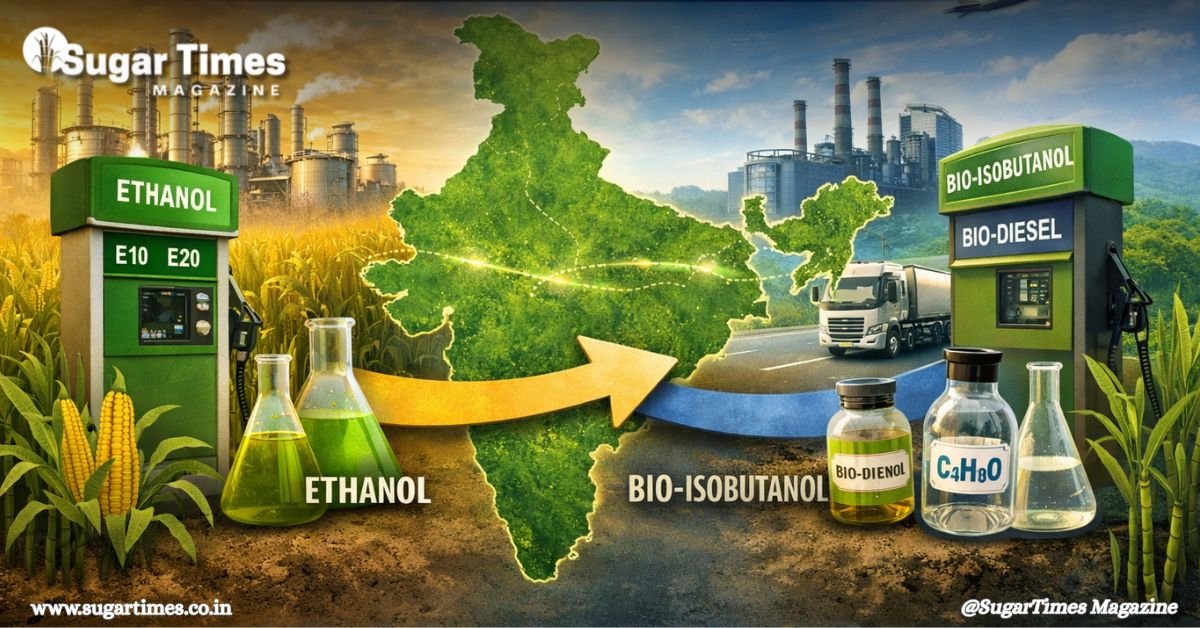
If the first phase of India’s biofuel development was centred on ethanol, the next stage is expected to focus on advanced biofuels, particularly those that can be used in diesel engines.
While ethanol has easily blended with petrol, replacing or blending fuels with diesel is more challenging. Diesel engines require fuels that can work smoothly with existing engines and fuel infrastructure while maintaining similar fuel properties. This has led to growing interest in bio-isobutanol, an advanced alcohol that is considered more compatible with diesel.
Technically, bio-isobutanol offers several advantages over ethanol. It has higher energy density, better blending capability without additional agents, and improved compatibility with diesel engines, making it a promising option for large-scale use in the diesel fuel mix.
India has already made progress in developing this technology. Praj Industries has spent more than a decade researching and refining bio-isobutanol production and has now validated the technology for diesel blending. The process and fuel performance have been evaluated with support from organisations such as Bharat Petroleum Corporation Limited, the Automotive Research Association of India, and several global engine manufacturers.
One of the key strengths of bio-isobutanol is that it can be integrated into existing ethanol plants through modular add-on systems. This allows producers to switch between ethanol and bio-isobutanol depending on market demand. Such flexibility could also help utilise India’s ethanol surplus, estimated at around 800 crore litres.
Experts believe that advanced biofuels will play an important role in India’s long-term energy transition. According to Sanjay Ganjoo, Director-General of the Indian Federation of Green Energy, expanding the use of advanced biofuels is closely linked to India’s goals of energy security and decarbonisation. He noted that reducing dependence on fossil fuels—especially in high-consumption sectors like diesel—will require scaling up a diverse range of domestically produced fuels.

However, policy support will be crucial for the success of such technologies. India’s ethanol programme grew rapidly because of clear government policies, blending mandates, price support, and assured demand. Experts believe that a similar framework will be required for diesel substitutes such as bio-isobutanol, including defined blending targets, fuel standards, and incentives for large-scale production.
Without strong policy alignment, even promising technologies may remain limited to pilot projects. As India looks to redesign its energy system and reduce dependence on imported fuels, expanding the range of viable biofuels will be essential.
Ethanol has already laid the foundation for India’s biofuel programme. The next phase will focus on building on that base and extending cleaner fuel solutions across the entire energy sector, particularly in diesel, where progress has been slower but the potential impact is significant.


