




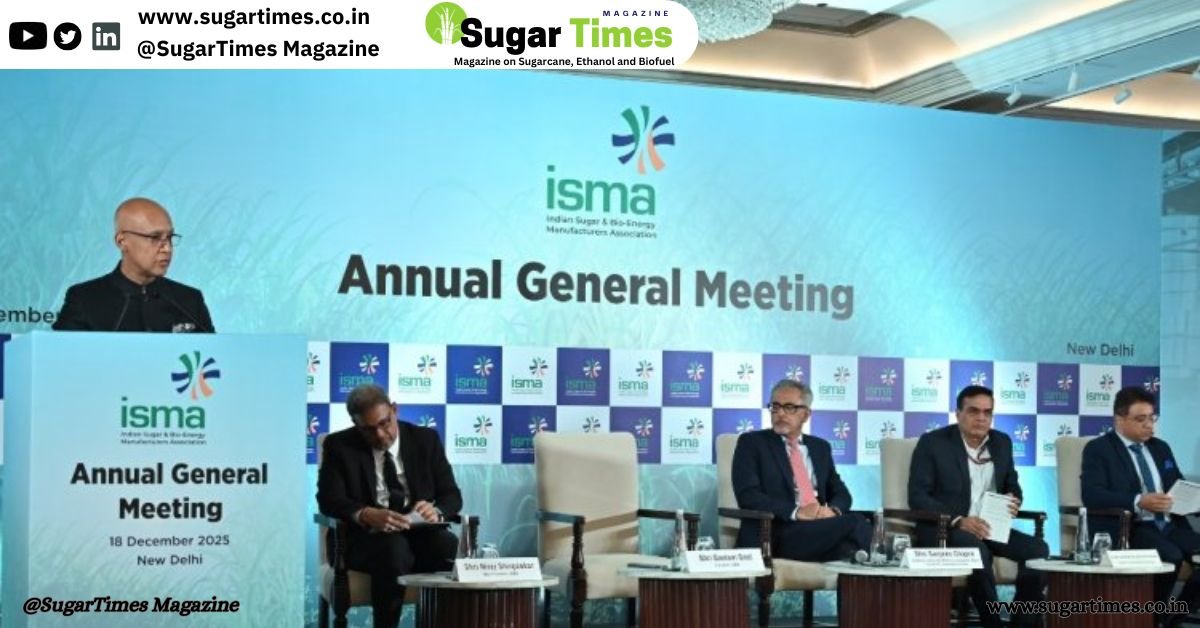
The Indian Sugar & Bio-Energy Manufacturers Association (ISMA), at its Annual General Meeting held in New Delhi, laid out a forward-looking roadmap to strengthen India’s sugar and bio-energy industry. The Association reiterated its commitment to work closely with the Government of India and industry stakeholders to ensure long-term financial viability, improve competitiveness, and promote sustainable growth.
Concern over sugar prices and mill viability
ISMA flagged the sharp decline in sugar prices, noting that current market rates are below production costs. The Association stressed that an early upward revision in the Minimum Selling Price (MSP) is essential to protect the financial health of sugar mills, ensure timely payments to farmers, and prevent the build-up of cane arrears.
Focus on strengthening the ethanol ecosystem
Highlighting rising input and operating costs, ISMA called for an upward revision in ethanol procurement prices for the 2025–26 Ethanol Supply Year. It pointed out that ethanol prices have remained unchanged for the past three years despite higher costs.
The Association also underlined the need for a level playing field for private sugarcane-based ethanol producers to sustain investments and expand capacity. To ensure steady ethanol demand, ISMA said it will continue to push for lower GST rates and fiscal incentives for Flex-Fuel and Strong Hybrid Vehicles (FFVs/HEVs). Wider adoption of such vehicles, it noted, is the most practical way to fully utilise the ethanol production capacity already created in the country.
Policy clarity beyond E20 blending
For long-term investor confidence, ISMA urged the government to announce a clear, phased roadmap for ethanol blending beyond E20. It also highlighted diesel blending with Iso-Butanol as a promising opportunity to further diversify India’s biofuel mix.
Positive sugar production outlook
ISMA reaffirmed its first advance sugar production estimate for the 2025–26 season at 343.5 lakh tonnes. The estimate is supported by better yields, higher recovery rates in major sugar-producing states, and satellite-based assessments of Maharashtra and Karnataka. Crushing data as of mid-December 2025 shows a 28 per cent year-on-year increase, indicating a strong start to the season.
Commenting on the outlook, ISMA President Gautam Goel said the industry is at a critical juncture and must address immediate financial stress while preparing for technology-driven and diversified growth. Vice President Niraj Shirgaokar described ethanol as a key pillar of India’s energy transition and stressed the need for timely price revisions and policy clarity beyond E20 to support continued investment. Director General Deepak Ballani said future priorities will include digitalisation of mills, development of advanced cane varieties, and expansion into bio-based manufacturing, aligned with the goals of Atmanirbhar and Viksit Bharat.
New leadership announced
ISMA also announced new office-bearers for the upcoming term. Niraj Shirgaokar has been elected as the new President, while Madhav Banshidhar Shriram will serve as Vice President.
The Association thanked outgoing President Gautam Goel for his leadership during a period marked by major policy and market challenges, particularly in expanding the ethanol programme and advancing regulatory reforms.
Taking charge, President-elect Niraj Shirgaokar said he is honoured to lead the industry at a crucial phase and assured continued engagement with the government to build a more resilient and future-ready sector. Vice President Madhav Banshidhar Shriram said ISMA will focus on expanding ethanol capacity, driving technological innovation, and strengthening sustainability across the sugar value chain.
ISMA reiterated its commitment to a balanced growth approach that supports farmers, ensures industry viability, and contributes to India’s energy security and sustainability goals.


