





From shrinking demand forecasts to zero-waste factory models, India’s premier sugar industry conference tackles the sector’s most pressing challenges head-on
New Delhi, April 7, 2026 — India’s sugar and bio-energy sector gathered at Hotel Taj Mahal, Mansingh Road, New Delhi for ISMA’s SugarNXT 2026 Conference — a platform that this year carried unusual urgency, with the industry navigating a confluence of geopolitical shocks, financial stress, and an accelerating push toward sustainable operations.
Demand Takes a Hit as External Shocks Bite
The season’s consumption arithmetic has been upended by two factors that few in the industry could have predicted at the start of October. The escalating conflict in West Asia and widespread disruptions in LPG availability — which forced countless roadside eateries and small food establishments to cut back operations — have together knocked an estimated 6 LMT off India’s sugar demand projection for 2025–26.
ISMA Director General Deepak Ballani, speaking on the conference sidelines, confirmed that the revised consumption estimate now stands at 277 LMT, pulled down from an earlier forecast of 283 LMT. The irony is that the season began on a strong note — despatches between October 2025 and February 2026 were running nearly 60,000 tonnes ahead of the previous year. The West Asia conflict’s escalation changed that trajectory sharply.
The LPG crunch compounded matters further. With dhabas and small restaurants — collectively a significant sugar-consuming segment — reducing their operations, nearly 2 LMT of sugar from the monthly government release quota remained unsold. Ballani cautioned that if geopolitical tensions persist, the demand slowdown may extend well into April.
Production Healthy; Exports Modest
India’s gross sugar output for the season is estimated at around 320 LMT, with 34 LMT being diverted toward ethanol manufacturing — a figure that reflects both the government’s blending ambitions and the financial constraints limiting deeper diversion. Sugar production as of March 31, 2026 had already reached 272.31 LMT, approximately 9% higher than the year-ago level.
Export ambitions, however, remain firmly capped. Outbound shipments for the full season are unlikely to breach the 8 lakh tonne mark, as the priority remains domestic market stability over global trade volumes.
Arrears Tell the Real Story
Strip away the production numbers and what remains is a sector under acute financial stress. Sugarcane payment arrears have climbed to ₹16,000 crore — ₹5,000 crore worse than at the same point last season. The cause is structural: mills are locked into government-mandated cane procurement prices while sugar realisations have trended downward through much of the season, squeezing margins and draining working capital.
Harshvardhan Patil, President of the National Federation of Cooperative Sugar Factories (NFCSF), did not mince words. Maharashtra’s cooperative mills, he said, are under severe financial strain — caught between high cane costs and a Minimum Selling Price (MSP) of sugar that has not been revised in years despite a steady rise in production expenses. He urged the government to act swiftly on MSP revision, calling it essential to restore cash flows and prevent the arrears situation from deteriorating further.
Ballani reinforced the point, noting that with cane price hikes across multiple states, the cost of producing sugar has risen to approximately ₹41.7 per kg — rendering the existing MSP framework increasingly indefensible.
Sustainability Takes Centre Stage
Beyond the immediate financial turbulence, SugarNXT 2026 also trained its lens on the longer horizon. Session 6 of the conference, scheduled for April 8 from 3:15 PM to 4:45 PM, will focus on by-product valorisation, zero-waste processing, and water efficiency — themes that are rapidly moving from aspiration to operational necessity for Indian sugar mills.
Chaired by Sh. Ashwini Srivastava, Joint Secretary (Sugar), DFPD, Government of India, and moderated by Padma Shri Prof. G.D. Yadav, the session will feature Dr. Sangeeta Srivastava of Godavari Biorefineries, Dr. Anjan Ray of Navam Capital, and Abhishek Tripathi. Together, they will explore how mills can convert bagasse, press mud, wastewater, and other residual streams into revenue-generating opportunities — and how smarter water management can reduce both costs and environmental liability.
For an industry where sugar alone can no longer guarantee financial viability, the circular economy model is emerging as a lifeline. Mills that master by-product valorisation stand to unlock new income streams while reducing their dependence on the volatile sugar price cycle.
Action Over Aspiration
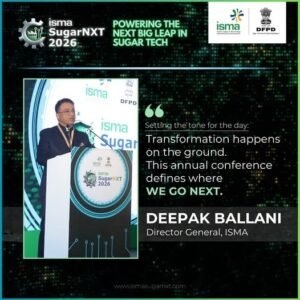
Ballani’s closing message at the conference cut through the complexity with clarity: transformation in this sector will not come from conferences alone — it demands execution at the ground level, mill by mill, season by season. Platforms like SugarNXT, he said, matter precisely because they translate big-picture thinking into actionable direction for the thousands of stakeholders — farmers, millers, policymakers, and investors — whose livelihoods are bound up in this industry’s future.
As India’s sugar and bio-energy sector stands at a crossroads — navigating geopolitical headwinds, financial stress, and a sustainability imperative all at once — the conversations at SugarNXT 2026 may well define what the next chapter looks like.


