

NEW DELHI: India’s sugar and bio-energy sector is witnessing a major shift towards advanced clean-energy solutions, with green hydrogen, sustainable aviation fuel (SAF), green methanol and compressed biogas (CBG) emerging as key areas of focus. The developments were highlighted at the India Sugar & Bio-Energy Conference 2026, held at the JW Marriott Hotel in Aerocity, New Delhi, under the theme “Powering India’s Energy Security.” The conference brought together government officials, industry leaders, clean-tech investors and agricultural experts to discuss the future of India’s sugar mills and their transition into integrated, multi-product bio-refineries. 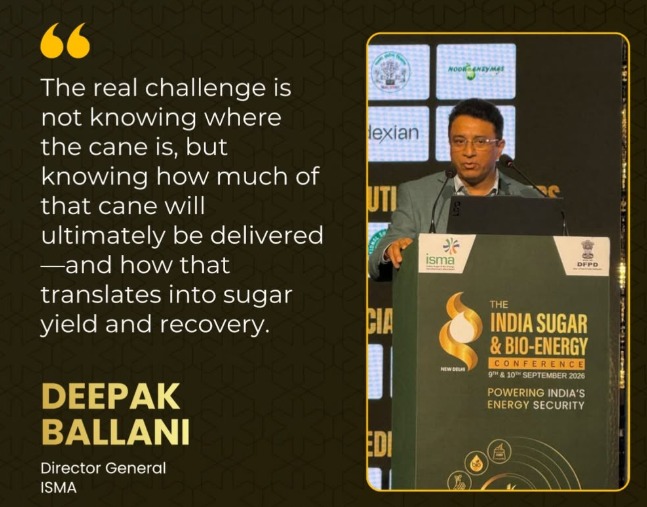
Addressing the ministerial session, Santosh Kumar Sarangi, Secretary, Ministry of New and Renewable Energy (MNRE), highlighted the changing role of Indian sugar mills in the country’s energy transition. The industry is increasingly moving beyond conventional sugar and ethanol production towards new-generation fuels and energy products, including green hydrogen, sustainable aviation fuel, green methanol and compressed biogas. The diversification is expected to provide sugar mills with new revenue opportunities while contributing to India’s broader clean-energy and energy-security objectives.
Research and technology development are also playing an important role in expanding the bio-energy potential of the sugar industry. The National Institute of Bioenergy (NIBE), Kapurthala, is working on technologies to convert sugarcane bagasse and other fibrous agricultural residues into biogas. With support from government initiatives such as the GOBARdhan platform, such projects could help create stronger domestic sources of renewable energy and reduce India’s dependence on imported fossil fuels. The wider use of agricultural residues for energy production could also help the country manage global energy-price volatility and strengthen its domestic energy supply chain.
The future of ethanol and flex-fuel mobility was another major focus of the conference. Tarun Kapoor, Advisor to the Prime Minister’s Office, speaking virtually, said India’s domestic fuel production capacity has moved beyond the requirements of existing blending targets. Policymakers are now examining the possibility of increasing ethanol blending levels beyond the current E20 framework, creating additional opportunities for the use of domestically produced ethanol.
Higher ethanol blending could also accelerate the introduction of flex-fuel vehicles in India. Automobile manufacturers are preparing to introduce next-generation flex-fuel models across both the two-wheeler and four-wheeler segments. Such vehicles could provide consumers with greater flexibility in fuel use while helping India increase the utilisation of domestically produced ethanol. Kapoor also highlighted the importance of alternative domestic fuels amid geopolitical uncertainties, noting that tensions in West Asia could disrupt maritime energy supply routes and put upward pressure on international crude oil prices, potentially pushing them towards $100 a barrel. 
The conference also highlighted the growing importance of sugarcane as a strategic crop for India’s energy transition. Niraj Shirgaokar, President of the Indian Sugar & Bio-Energy Manufacturers Association (ISMA), emphasised that sugarcane should increasingly be viewed not only as a food and industrial crop but also as an important source of renewable energy. The crop provides raw material for ethanol, bagasse-based power, biogas and other emerging bio-energy applications, strengthening its role in India’s future energy mix.
Alongside developments in biofuels, the conference placed significant emphasis on the use of artificial intelligence and digital technologies in sugarcane agriculture and sugar manufacturing. Industry and policymakers are closely watching weather patterns and seasonal conditions as they assess crop and production prospects for the upcoming season. Better access to real-time agricultural data could help improve production estimates and enable mills and farmers to make more informed decisions.
A key highlight of the opening day was the release of an industry whitepaper prepared in collaboration with PwC, titled “From Cane to Cloud: The Next Era of AI-Powered Sugar Manufacturing.” The report outlines the potential of cloud computing, satellite-based crop monitoring and predictive artificial intelligence to transform sugar manufacturing and sugarcane management. These technologies can help improve yield forecasting, monitor crop conditions, optimise factory operations and provide timely weather-related information to farming communities. 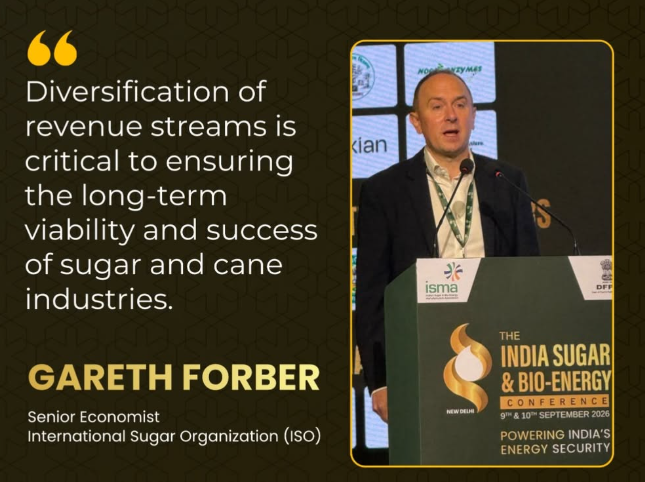
The discussions at the India Sugar & Bio-Energy Conference 2026 reflect the rapidly evolving role of India’s sugar industry. From ethanol, CBG and bagasse-based energy to green hydrogen, SAF and AI-driven manufacturing, sugar mills are increasingly being positioned as integrated bio-energy hubs. The shift could enable the sector to diversify beyond traditional sugar production while contributing to India’s long-term goals of energy security, reduced fossil-fuel dependence and a cleaner energy economy.


